Death by Meeting: A Summary and What Your Team Can Do About It
If you've ever attended a status meeting that could have easily been handled as an email, you can relate to the basic premise in Patrick Lencioni's Death by Meeting. This death by meeting summary covers the primary point, the four types of meetings that Lencioni identifies, and what has remained relevant about the book over twenty years since its publication.
The basic idea of Lencioni's book is that most companies have one large sloppy meeting that tries to accomplish too many things at once, which is why nobody wants to attend. To fix that, Lencioni breaks the single meeting into four separate meetings, each with its own purpose, duration, and tone.
Below is the full breakdown, plus some practical takeaways your team can use this week.
Who Wrote It and Why It Still Matters
Patrick Lencioni founded The Table Group and wrote the book "The Five Dysfunctions of a Team". In his second business fable, "Death by Meeting", released in 2004, the main character (a fictional CEO) at a failing sports software company brings in an outside expert that changes how the company holds meetings.
The book is extremely short. Most readers finish it in less than three hours. About two-thirds of the book is the fable, and the remaining third contains the framework model.
Twenty years after this book was first published, it is still being passed on to new managers as a solution to a problem that has become much more severe. According to Microsoft's Work Trend Index, the amount of time spent in meetings by the typical knowledge worker has increased threefold since 2020. While the way people hold meetings has changed with the rise of video calls and multiple communication channels, the problems that Lencioni addressed remain consistent.
The Two Core Problems Lencioni Identifies
Lencioni states that poor meeting quality is due to two fundamental reasons:
- Lack of drama. Meetings without real conflict feel pointless because nothing is at stake. Healthy debate creates urgency. When leaders smooth over disagreements to keep things polite, the meeting becomes theater.
- Lack of contextual structure. Most teams cram strategy, tactics, status updates, and brainstorming into a single weekly meeting. The brain cannot switch gears that fast. The result is a long, draining session where nothing gets the focus it deserves.
His framework targets both of these directly.
The Four Meeting Types Lencioni Proposes
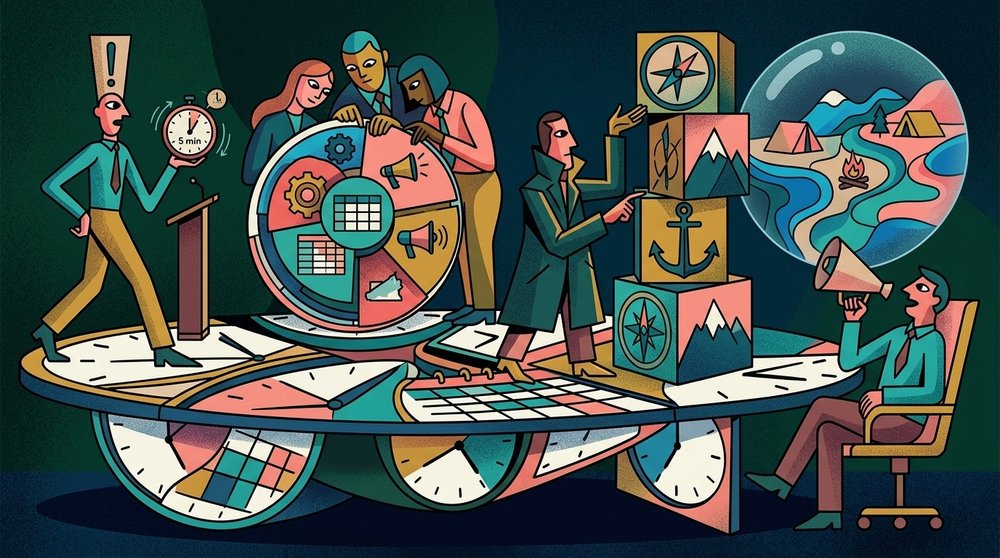
The book proposes an alternative format that divides the function of meetings across four different formats, each with its own objectives and restrictions on time.
1. The Daily Check-In (Five Minutes)
At the beginning of each day there is a quick standing huddle (if everyone can be present). Everyone states their work for that day, and if anyone has anything conflicting with others' work they will mention it. The purpose of this meeting is to make sure all team members know about the projects being worked on that day.
Lencioni states firmly that the meeting needs to be a maximum of five minutes, standing is better than sitting, and no agenda is better than an agenda.
2. The Weekly Tactical (45 to 90 Minutes)
This is the team's primary working meeting. The agenda is developed in real time during a quick lightning-round process, in which each member shares their number one priority for the week. The team then debates the issues of actual importance to them, in order of priority.
The most important rule is that the agenda is generated by people in the room, not from an old calendar invite made four days prior. By the time you've heard each person present their lightning round, you will be able to determine which items are worthy of discussion.
3. The Monthly Strategic (Two to Four Hours)
Teams spend a concentrated amount of time focusing on no more than two significant strategic topics. The focus is on non-tactical and non-routine topics. It's where teams engage in difficult conversations regarding future direction, the need to hire key employees, changes within target markets, or the viability of product bets.
Lencioni claims that a lot of teams either completely omit this meeting from their calendar or squish it into one of their weekly tactical meetings, which is why strategy is typically talked about briefly but never formally decided on.
4. The Quarterly Off-Site Review (One to Two Days)
Step outside of the daily routine to assess your company's strategy across the whole year and evaluate how healthy your team is. Review what you are doing competitively and reset priorities for each department over the course of a year. Lencioni cautions that the goal should be a working meeting with some time to plan ahead. Corporate retreats with trust-building and motivational speeches are not the best use of this time. Focus on the work.
The Two Bigger Ideas Behind the Framework
The four different kinds of meetings receive a lot of focus, but it is actually the underlying debate that gives this book its value.
Mining for Conflict
Lencioni suggests that as a leader, you are responsible for creating an environment in which disagreements are encouraged. If your team is silent, you need to draw those ideas into the conversation by naming names ("Sarah, I know you have reservations about the launch date, let's hear your thoughts").
This is the section of the book that will remain relevant for years. The likelihood of surface-level agreement on remote or hybrid teams is higher than ever, because Zoom rewards politeness. A meeting where nobody pushes back is rarely a meeting where good decisions get made.
Real-Time Agenda Setting
The second counterintuitive concept is that pre-determined agendas can be harmful to a meeting. Pre-set agendas restrict conversation to what was determined as important at the time the invite was sent, whereas it would have been better to surface the items that matter right now.
The reason this is effective is that the team has an understanding of what matters and they simply needed a time structure for them to be able to bring those items to light.
What Lencioni Got Right and What He Missed
The diagnosis is sharper than the prescription. Here's how it stands today and which things don't hold up as well.
What holds up:
- Mixing meeting types is the single biggest reason meetings feel draining
- Conflict avoidance is the single biggest reason meetings feel pointless
- Most leaders run too few strategic meetings, not too many
What did not age as well:
- The model assumes everyone is in the same room. Async work and time zones break the daily check-in
- The hard time limits (5 minutes, 45-90 minutes) feel arbitrary when applied to remote teams
- The book has almost nothing to say about documentation, recording, or what happens after the meeting ends
Lencioni was writing before the era of meeting recordings, transcripts, and AI summaries. The big question today (2026) is no longer "how can I make my meetings better?" but rather "do I need to have a meeting at all?"
Stats That Back Up the Argument
Numbers will help make your case to an unconvinced leader.
- The average employee attends 62 meetings per month, and considers half of them a waste of time
- Knowledge workers report that unnecessary meetings cost large companies tens of thousands of dollars per employee per year
- Microsoft's data shows the average Teams user is in 250 percent more meetings per week than they were before 2020
The trends are clear across all of these studies: meeting volume continues to grow while attendees perceive less value from their participation.
Applying the Book in 2026
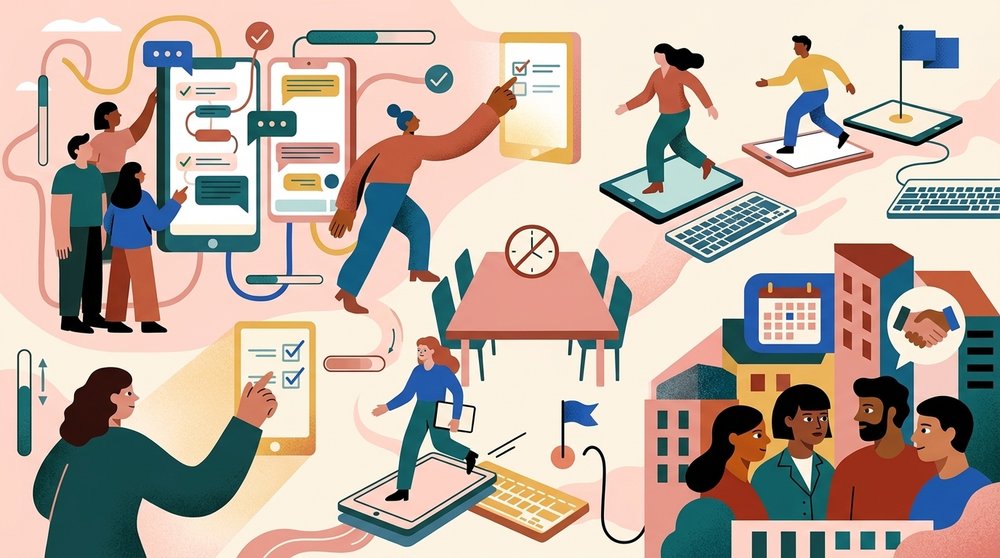
Although the four-meeting framework still works, it needs an update for distributed teams. The version below is one your team can use starting this week.
Replace the Daily Check-In with a Written Standup
Slack threads, Notion docs, or a dedicated stand-up tool are better than a five-minute call across time zones. Same purpose, less friction.
Keep the Weekly Tactical, But Record It
The lightning round and real-time agenda are still gold. The difference is that anyone who missed the meeting gets the recording and summary instead of a forwarded calendar invite for next week. If you use Shmeetings, our offline meeting note taker guide walks through a setup that records the meeting locally and produces a recap.
Protect the Monthly Strategic
Schedule this meeting a year out to make sure everyone shows up, block off all non-strategic items from your agenda, and adjourn right on time.
Treat the Quarterly Off-Site as a Reset, Not a Retreat
Two days, structured agenda, real results. Unless you have a genuinely dysfunctional team, skip all the team-building stuff.
Cut the Meetings That Do Not Fit Any of the Four
Most readers fail to see this big-picture point. If a meeting is not a daily check-in, a weekly tactical, a monthly strategic, or a quarterly off-site, it may simply not be worth having. Status updates can typically be sent as a Loom video or a written document. Decisions requiring input from three people can usually be handled in a brief call rather than a calendar block. Brainstorming can start asynchronously, with everyone contributing ideas independently, and then converge in a short meeting.
The most efficient approach is to evaluate all meetings over the past two weeks. Anything that does not fit one of these formats is a candidate for removal, and a transcript or meeting summary can usually take its place. Tools like Shmeetings make this easy because you get a searchable transcript and an AI-generated summary without uploading your audio to a cloud server.
Frequently Asked Questions
Is Death by Meeting worth reading in full?
The fable is fast-paced and fun to read, and the model section at the back of the book is short enough that you can learn the framework in twenty minutes. If you only have time for one portion, read the model. For a first-time manager, the fable is worth the extra hour because it shows the framework in motion.
What is the main idea of Death by Meeting?
Most meetings are poorly constructed because teams typically mix several different types of conversations into one session, and teams also avoid real conflict. Lencioni's fix is to split work across four meeting types so that each session only handles one type of conversation. He also argues that teams stay healthier when they actively encourage debate.
Are the four meeting types still relevant?
Yes, but in modified form. The daily stand-up is well-suited for a written remote version. The remaining three formats adapt easily to video calls as long as each format keeps its specific purpose.
What is the difference between the weekly tactical and the monthly strategic?
The weekly tactical meeting handles operational issues, status, and priorities over a short time frame. The monthly strategic meeting focuses on one or two major questions about direction or major bets that will shape the team's future. Most teams mix them, and that is the most common mistake.
How long should each meeting type be?
Lencioni recommends 5 minutes for the daily check-in, 45 to 90 minutes for the weekly tactical, 2 to 4 hours for the monthly strategic, and 1 to 2 full days for the quarterly off-site.
Can AI meeting tools replace some of these meetings?
Some, yes. With AI meeting summaries and recorded status updates, several meeting types can shift to async. The tactical (weekly) and strategic (monthly) debates still benefit from being live, because the value comes from the real-time discussion. Tools like Shmeetings handle the recording and summary side while keeping all your recordings locally on your machine instead of sending them to the cloud, which is useful for sensitive topics.
What is the bottom line of Death by Meeting?
Death by Meeting has remained effective because it makes a more precise diagnosis of what goes wrong in most meetings than just about anything that has been published since. Meetings typically fail for two reasons: organizers try to accomplish multiple objectives in one session, and participants are not willing to openly disagree with each other. Combine the four-meeting framework with modern async tools like transcripts and AI summaries, and you can hold fewer meetings, run better ones, and build a record of past decisions for future reference.